Wi-Fi Surveillance
 Wi-Fi Can Now Recognize People Without Cameras
WiFi has always seemed like background infrastructure. It connects phones, laptops, TVs, smart speakers, cameras, thermostats, and countless other devices without most people thinking much about the invisible radio waves moving through a room. But new research shows that those same signals can reveal far more than whether someone has a strong Internet connection. Under the right conditions, ordinary Wi-Fi activity can be used to recognize individual people with striking accuracy, even when they are not carrying a phone, smartwatch, or other connected device. In other words, your Wi-Fi router could be watching you!
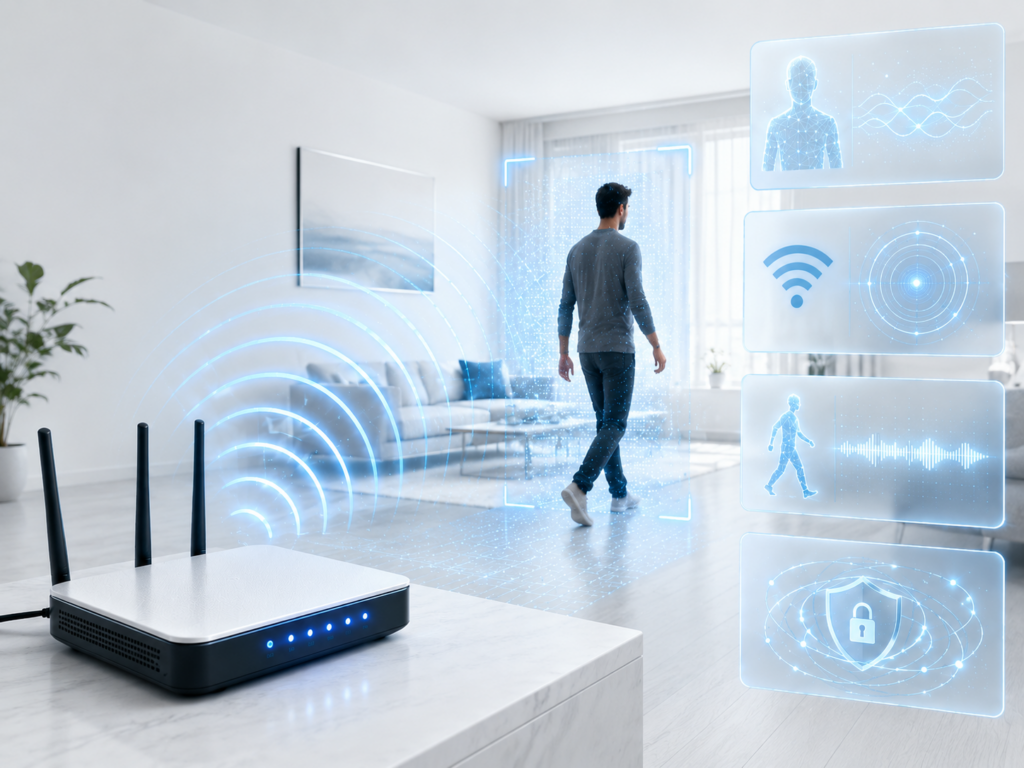
The basic idea is simple, but unsettling. Wireless signals do not travel through a room in a perfectly clean line. They bounce off walls, furniture, doors, and human bodies. Every person moving through that signal field slightly changes the way those waves reflect, scatter, and weaken. With enough data, AI software can analyze those tiny changes and turn them into a kind of radio based signature. It is not a normal photo, but it can function like an invisible sensing system that notices a person’s movement, body shape, and gait.
The key technical detail is something called beamforming feedback information, or BFI. Beamforming was introduced with Wi-Fi 5 to help routers aim signals more efficiently toward connected devices. To make that work, devices send feedback to the router about the current signal environment. That feedback can include clues about how radio waves are moving through the space, and current implementations can transmit it in a readable form to anyone within range.
This matters because older Wi-Fi sensing experiments often depended on more specialized data, custom firmware, or specific hardware. BFI lowers the barrier. The research suggests that a person with ordinary WiFi equipment could potentially gather useful sensing data without needing expensive cameras, lidar, or purpose built surveillance gear. In other words, the risk is not just that Wi-Fi sensing exists. The risk is that the technical ingredients are already built into many modern wireless environments.
The Privacy Risk Hiding Inside Everyday WiFi
In the study, researchers recorded Wi-Fi data from 197 participants and tested whether the system could link recordings of the same person over time. Their BFI based approach reached about 99.5 percent accuracy in one main test, and the method remained robust across different walking styles and viewing perspectives. Participants were recorded walking normally, walking faster, carrying objects, wearing a backpack, and passing through a turnstile, which helped test whether the system was only recognizing one very specific type of movement.
It is important to understand what “identify” means in this context. The system does not magically know a stranger’s name from a Wi-Fi signal. More accurately, it can recognize that the same person has appeared before. If a person’s signal pattern is later linked to a real identity through another source, such as a login, a camera, a payment, a workplace badge, or repeated visits to a known location, that anonymous radio signature could become personally identifying. That is what makes the technology powerful: it can break anonymity first, and a name can potentially be attached later.
Turning off your own phone may not be enough in every situation. The technique does not depend on the target carrying a device. It depends on WiFi devices nearby communicating with a 192.168.1.1 admin router and creating enough signal activity to observe how the environment changes. In a home, office, café, airport, hotel, school, store, or apartment building, there may be plenty of devices generating wireless traffic even if one person has disabled their own phone. That said, the practical effectiveness would still depend on signal strength, network layout, traffic patterns, building materials, distance, and whether the attacker can collect enough useful data.

That nuance is worth stressing because this should not be treated as science fiction or as instant, universal surveillance. The study was controlled, the system required training data, and the researchers themselves noted limitations. For example, participants were asked not to wear baggy clothes, skirts, dresses, or heeled shoes so the gait recordings would be clearer. The researchers also tested a specific setup, and everyday environments can be messier, with more people, more interference, different walls, changing furniture, and inconsistent wireless traffic.
Even with those limits, the broader direction is clear. WiFi sensing has been studied for years for motion detection, fall detection, elder care, occupancy monitoring, gesture recognition, and smart home automation. Some consumer services already use Wi-Fi signals between gateways and connected devices to detect movement in a home, often marketed as a camera free way to know whether motion is happening in certain areas.
That is why this technology is best understood as dual use. In a beneficial setting, it could help detect whether an older adult has fallen, whether a room is occupied during an emergency, or whether a home has unexpected movement without placing cameras in private spaces. In a harmful setting, the same underlying concept could be used to track workers, monitor customers, identify protesters, follow people through public spaces, or build hidden profiles of who visits certain locations. The difference is not just the signal processing. It is consent, transparency, governance, and control.
The most worrying settings are places where people do not meaningfully choose the wireless environment around them. A café, mall, workplace, apartment hallway, school, border area, hospital, or public transit station may have multiple wireless networks operating in the background. A person may not know who controls them, what data is being collected, or whether sensing features are enabled. Unlike a camera, a Wi-Fi router does not look like a surveillance device. That invisibility makes notice and consent much harder.
Simple fixes are not obvious. Encrypting or restricting beamforming feedback may help, but wireless standards need to balance privacy with performance and compatibility. Reducing the amount of feedback might also reduce sensing accuracy, but the study found BFI based identification remained strong even when sample rates were lowered. Consumer level countermeasures are also limited. Jamming wireless signals is not a realistic or lawful answer in many places, and turning homes or offices into radio shielded spaces is impractical for most people.
The bigger takeaway is that privacy rules need to catch up with ambient sensing. People already understand that cameras and microphones can record them, but Wi-Fi sensing blurs the line between infrastructure and surveillance. A router may no longer be just a router. As wireless standards evolve, regulators, manufacturers, and standards bodies will need to decide whether signal data that can reveal human presence, movement, and identity should be treated as sensitive personal information. The technology is impressive, but the central question is not whether WiFi can recognize people. It is whether society will allow invisible recognition systems to become part of everyday life without clear limits.